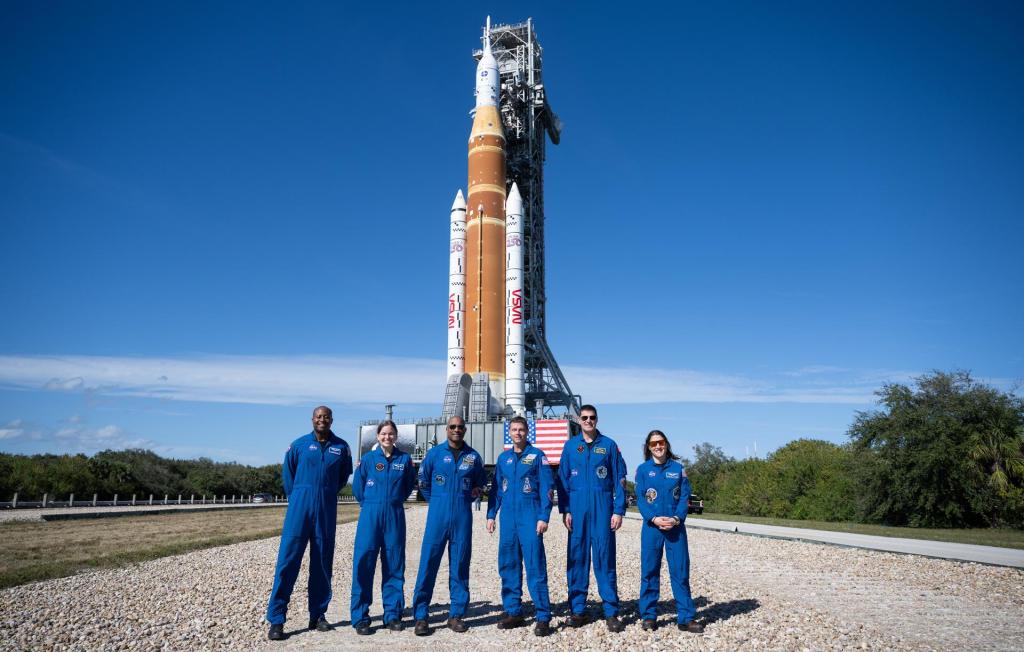
The Artemis II mission represents the next great technological leap toward the Moon, serving as the first crewed test of the program that aims to establish a sustainable presence in deep space. The primary objective of this journey is to validate the critical life support systems and the maneuvering capabilities of the Orion capsule in a lunar orbit environment, ensuring safety for future surface landing missions [1].
Aboard the spacecraft is a crew of four astronauts: Commander Reid Wiseman, Pilot Victor Glover, Mission Specialist Christina Koch, and Canadian Space Agency Specialist Jeremy Hansen. Together, they form the first team to travel to orbit the Moon in over 50 years, symbolizing an era of international cooperation and diversity in space exploration [2].
The official launch of this technological milestone took place on April 1, 2026, using the powerful SLS rocket from the Kennedy Space Center. Although the cost per individual launch is estimated at approximately US$ 2 billion, the total investment in the Artemis program already exceeds the US$ 93 billion mark, reflecting the technical complexity and financial ambition required to expand human frontiers beyond Earth’s orbit [3].
In 2022, the Artemis I mission took place, which served as an uncrewed test of deep space exploration systems. This mission sent the Orion capsule on a 25.5-day journey through space. The main difference between the missions is the human presence and operational complexity. Artemis I, conducted in 2022, was an uncrewed test focused on the structural endurance of the SLS rocket and the integrity of Orion’s heat shield. Artemis II, in turn, elevated the level of research by including four astronauts for lunar orbit, testing vital life support systems and manual maneuvers. While the first proved the technology was functional and safe, the second validated human capacity to operate in deep space, serving as the final rehearsal for the lunar landing [4].
The Artemis II mission represents a significant step for human deep space exploration, utilizing a free-return trajectory that ensures crew safety. After launch, the Orion capsule will spend about 24 hours in a high Earth orbit to validate all life support systems before being propelled toward the Moon. Upon reaching our natural satellite, the spacecraft will not enter low lunar orbit; instead, it will pass by the far side of the Moon at a distance of approximately 10,300 km from the surface, using lunar gravity as a “slingshot” to return naturally to Earth. This entire journey has a planned duration of 10 days—a short period, yet fundamental for testing human and technological performance beyond the protection of Earth’s magnetic field [5].
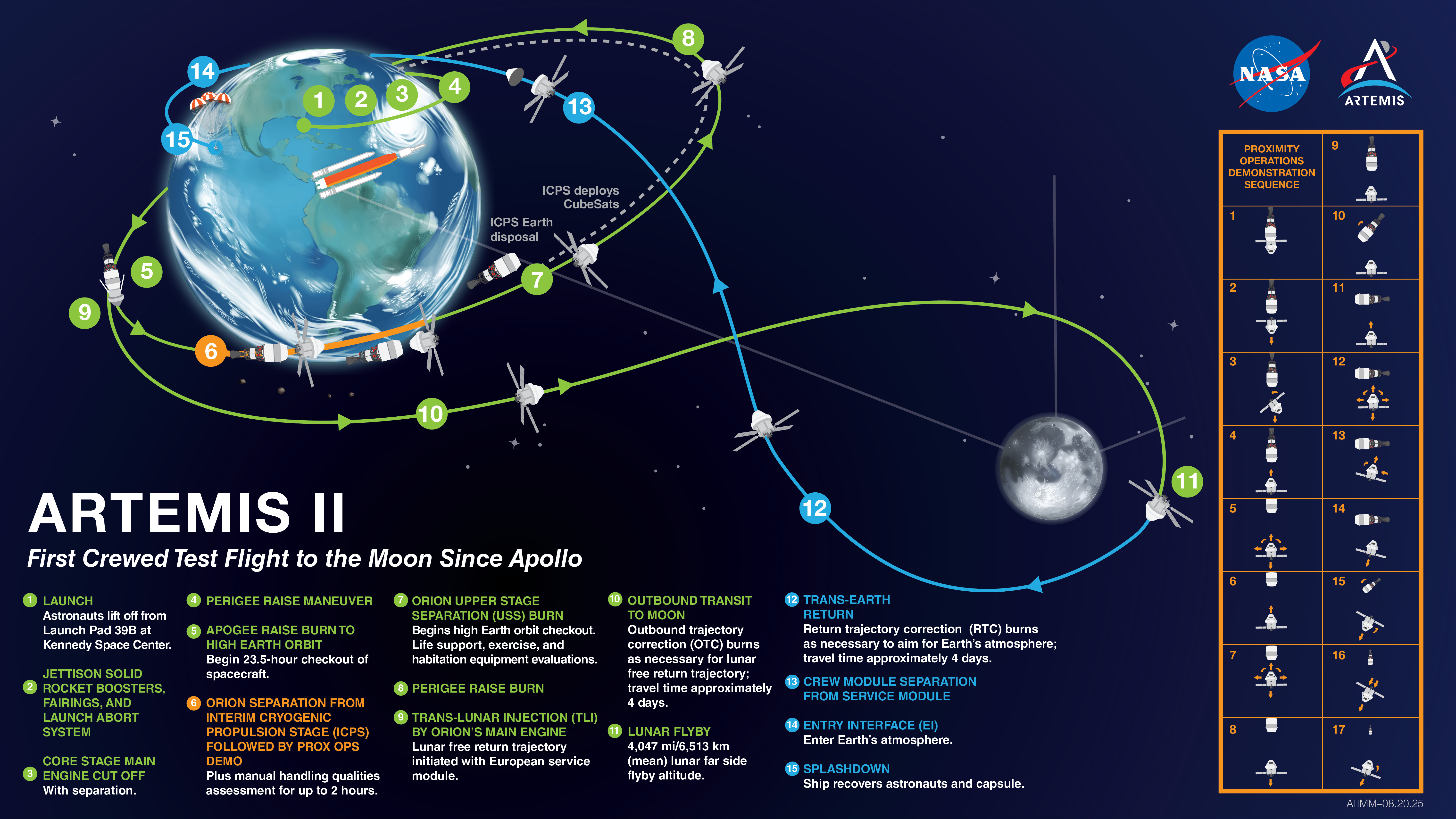
The expected results for the Artemis II mission consolidate the technological and biological foundation for a human permanence on the Moon. As the program’s first crewed flight, success will be measured by the Orion capsule’s ability to keep four astronauts safe in an environment of intense radiation and deep vacuum. One of the most critical points is the testing of the Environmental Control and Life Support System (ECLSS), which will be pushed to its limit to ensure that air and water recycling, as well as pressurization, function perfectly. Furthermore, this mission may also validate the readiness for the future Artemis III, which is expected to land a transport module on the Moon. Ongoing tests evaluate the module’s maneuverability and long-range communication systems [6].
The Artemis II mission will consolidate humanity’s return to deep space, proving that the SLS rocket and Orion capsule technology are capable of sustaining human life beyond Earth’s orbit. By validating critical systems such as the ECLSS and the free-return trajectory, NASA ensures the necessary safety for the next ambitious step: the lunar landing on Artemis III. This milestone not only concludes a testing phase initiated in 2022 but also inaugurates an era of sustainable exploration and international cooperation, reaffirming the Moon as a stepping stone to future journeys to Mars [7].
Dr. Cristiano Torres do Amaral
DOI: https://doi.org/10.5281/zenodo.19439882
References
[1] NASA. Artemis II: Mission Overview. Washington, DC: NASA, 2026. Disponível em: https://www.nasa.gov/artemis-ii. Acesso em: 6 abr. 2026.
[2] NASA. Artemis II Crew. Houston: Johnson Space Center, 2026. Disponível em: https://www.nasa.gov/specials/artemis-ii. Acesso em: 6 abr. 2026.
[3] NASA. Space Launch System (SLS): The World’s Most Powerful Rocket. Huntsville: Marshall Space Flight Center, 2026. Disponível em: https://www.nasa.gov/exploration/systems/sls/index.html. Acesso em: 6 abr. 2026.
[4] NASA. Artemis I: NASA’s First Step Toward Space Exploration. Washington, DC: NASA, 2022. Disponível em: https://www.nasa.gov/artemis-1. Acesso em: 6 abr. 2026.
[5] EUROPEAN SPACE AGENCY (ESA). Orion’s path to the Moon: Artemis II trajectory. Paris: ESA, 2026. Disponível em: https://www.esa.int/Science_Exploration/Human_and_Robotic_Exploration/Orion/Artemis_II. Acesso em: 6 abr. 2026.
[6] NASA. Life Support Systems for Orion: ECLSS Explained. Cleveland: Glenn Research Center, 2026. Disponível em: https://www.nasa.gov/glenn/exploration/life-support-systems. Acesso em: 6 abr. 2026.
[7] NASA. Artemis III: NASA’s First Mission to the Lunar South Pole. Washington, DC: NASA, 2026. Disponível em: https://www.nasa.gov/artemis-iii. Acesso em: 6 abr. 2026.
A Missão Artemis II: Desafios Tecnológicos e o Ensaio para o Pouso Lunar
A missão Artemis II representa o próximo grande salto tecnológico rumo à Lua, servindo como o primeiro teste tripulado do programa que visa estabelecer uma presença sustentável no espaço profundo. O principal objetivo desta jornada é validar os sistemas críticos de suporte à vida e as capacidades de manobra da cápsula Orion em um ambiente de órbita lunar, garantindo a segurança para futuras missões de pouso na superfície [1].
A bordo da nave, viaja a tripulação composta por quatro astronautas: o comandante Reid Wiseman, o piloto Victor Glover, a especialista de missão Christina Koch e o especialista da Agência Espacial Canadense, Jeremy Hansen. Juntos, eles formam a primeira equipe a viajar para orbitar a Lua em mais de 50 anos, simbolizando uma era de cooperação internacional e diversidade na exploração espacial [2].
O lançamento oficial deste marco tecnológico ocorreu em 1º de abril de 2026, utilizando o poderoso foguete SLS a partir do Centro Espacial Kennedy. Embora o custo por lançamento individual seja estimado em cerca de US$ 2 bilhões, o investimento total no programa Artemis já ultrapassa a marca de US$ 93 bilhões, refletindo a complexidade técnica e a ambição financeira necessárias para expandir as fronteiras humanas além da órbita terrestre [3].
Em 2022 ocorreu a missão Artemis I, a qual foi utilizada como teste não tripulado dos sistemas de exploração profunda. Essa missão enviou a cápsula Orion em uma jornada de 25,5 dias pelo espaço. A principal diferença entre as missões é a presença humana e a complexidade operacional. A Artemis I, realizada em 2022, foi um teste não tripulado focado na resistência estrutural do foguete SLS e na integridade do escudo térmico da Orion. Já a Artemis II, elevou o patamar da pesquisa, pois incluiu quatro astronautas para a órbita lunar, testando sistemas vitais de suporte à vida e manobras manuais. Enquanto a primeira provou que a tecnologia era funcional e segura, a segunda validou a capacidade humana de operar no espaço profundo, servindo como o ensaio final para o pouso lunar [4].
A missão Artemis II representa um passo relevante para a exploração humana do espaço profundo, utilizando uma trajetória de retorno livre que garante a segurança da tripulação. Após o lançamento, a cápsula Orion passará cerca de 24 horas em uma órbita terrestre alta para validar todos os sistemas de suporte à vida antes de ser impulsionada em direção à Lua. Ao chegar ao nosso satélite natural, a nave não entrará em sua órbita baixa, mas passará pelo lado oculto da Lua a uma distância de aproximadamente 10.300 km da superfície, utilizando a gravidade lunar como um “estilingue” para retornar naturalmente à Terra. Todo esse trajeto tem uma duração prevista de 10 dias, um período curto, mas fundamental para testar o desempenho humano e tecnológico além da proteção do campo magnético terrestre [5].
Os resultados esperados para a missão Artemis II consolidam a base tecnológica e biológica para a permanência humana na Lua. Como o primeiro voo tripulado do programa, o sucesso será medido pela capacidade da cápsula Orion de manter quatro astronautas em segurança em um ambiente de radiação intensa e vácuo profundo. Um dos pontos mais críticos é o teste do Sistema de Controle Ambiental e Suporte à Vida (ECLSS), que será levado ao limite para garantir que a reciclagem de ar e água, bem como a pressurização, funcionem perfeitamente. Além disso, esta missão também poderá validar a preparação para a futura Artemis III, que deverá pousar um módulo de transporte na Lua. Os testes em andamento avaliam a manobrabilidade do módulo e os sistemas de comunicação de longo alcance [6].
A missão Artemis II consolidará o retorno da humanidade ao espaço profundo, provando que a tecnologia do foguete SLS e da cápsula Orion é capaz de sustentar a vida humana além da órbita terrestre. Ao validar sistemas críticos como o ECLSS e a trajetória de retorno livre, a NASA garante a segurança necessária para o próximo passo ambicioso: o pouso lunar na Artemis III. Este marco não apenas encerra uma fase de testes iniciada em 2022, mas inaugura uma era de exploração sustentável e cooperação internacional, reafirmando a Lua como um trampolim para futuras jornadas a Marte [7].
Dr. Cristiano Torres do Amaral
DOI: https://doi.org/10.5281/zenodo.19439882
Referências
[1] NASA. Artemis II: Mission Overview. Washington, DC: NASA, 2026. Disponível em: https://www.nasa.gov/artemis-ii. Acesso em: 6 abr. 2026.
[2] NASA. Artemis II Crew. Houston: Johnson Space Center, 2026. Disponível em: https://www.nasa.gov/specials/artemis-ii. Acesso em: 6 abr. 2026.
[3] NASA. Space Launch System (SLS): The World’s Most Powerful Rocket. Huntsville: Marshall Space Flight Center, 2026. Disponível em: https://www.nasa.gov/exploration/systems/sls/index.html. Acesso em: 6 abr. 2026.
[4] NASA. Artemis I: NASA’s First Step Toward Space Exploration. Washington, DC: NASA, 2022. Disponível em: https://www.nasa.gov/artemis-1. Acesso em: 6 abr. 2026.
[5] EUROPEAN SPACE AGENCY (ESA). Orion’s path to the Moon: Artemis II trajectory. Paris: ESA, 2026. Disponível em: https://www.esa.int/Science_Exploration/Human_and_Robotic_Exploration/Orion/Artemis_II. Acesso em: 6 abr. 2026.
[6] NASA. Life Support Systems for Orion: ECLSS Explained. Cleveland: Glenn Research Center, 2026. Disponível em: https://www.nasa.gov/glenn/exploration/life-support-systems. Acesso em: 6 abr. 2026.
[7] NASA. Artemis III: NASA’s First Mission to the Lunar South Pole. Washington, DC: NASA, 2026. Disponível em: https://www.nasa.gov/artemis-iii. Acesso em: 6 abr. 2026.
Citation
Torres do Amaral, C. (2026). The Artemis II Mission: Technological Challenges and the Rehearsal for the Lunar Landing. In Amazontech: Revista de Esutdos Interdisciplinares (Vol. 8, Número 1). DOI: https://doi.org/10.5281/zenodo.19439882


 Amazontech: Journal of Interdisciplinary Studies - ISSN 2675-701X